
Moss on the unspoken
No 8 - The over-naming — a fragment

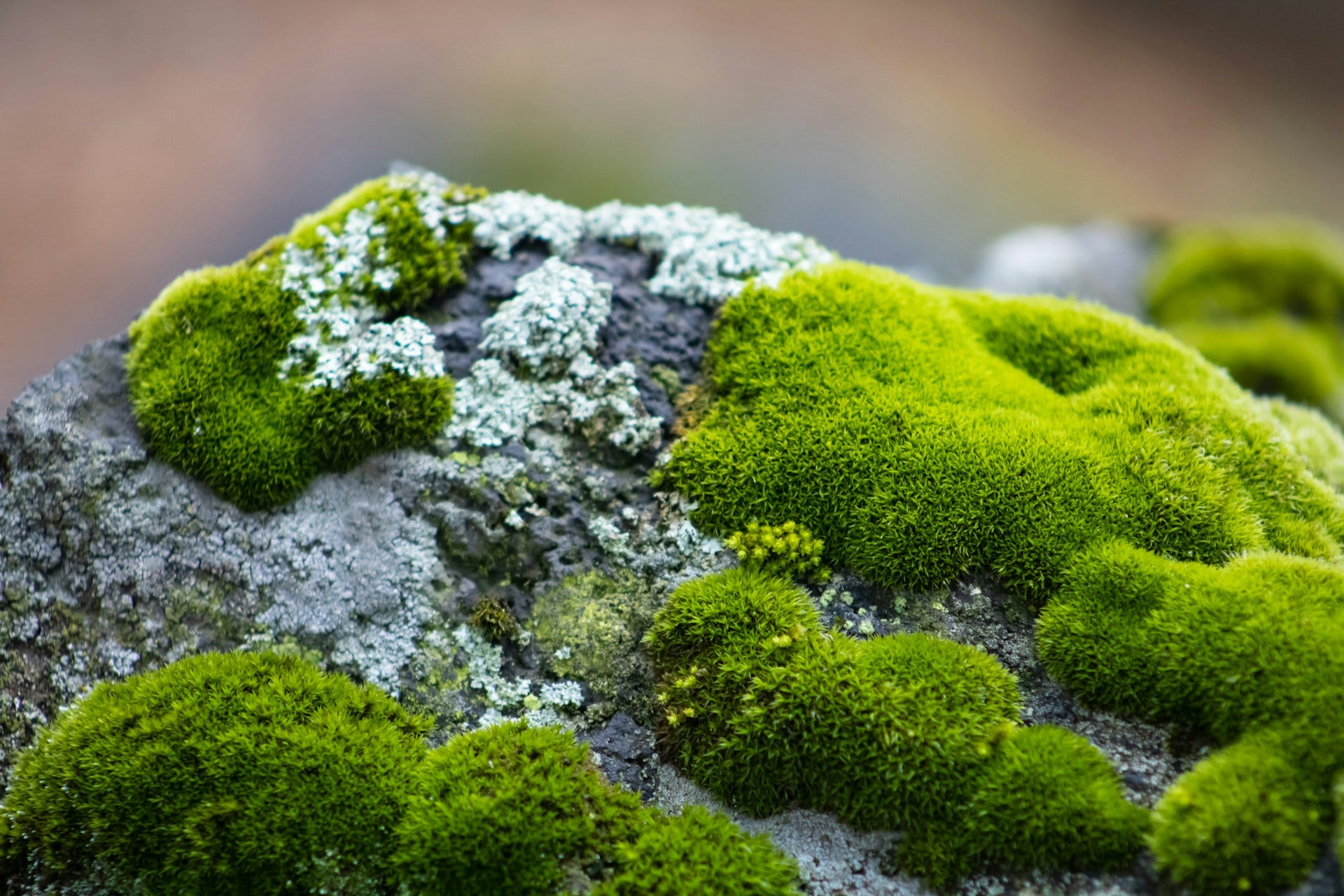
Photo by Aldo Hernandez on Unsplash
This post is out of the usual sequence - one post each week on Monday. The reason is this:
I want to demonstrate what the revised approach I will be taking from now on will look like.
The rationale for the new approach I discuss at length here.
Very soon, I’ll open a short window for subscribers to send me a poem to work on using the approach I’ve been developing.
That’s the second reason for sharing this post earlier than normal. If you choose to send me a poem, I’ll review the poem carefully, and then publish a small fragment along with the diagnosis of a single way the poem is reaching for something it doesn’t yet find.
You can preserve your anonymity if you wish.
Now, on to the autopsy.
The launch wave put whole poems on the slab — the entire draft laid out, every failure mode walked in order. This week I continue to work with fragments. Seven lines, lifted from a poem of forty-odd. The rest stays in the drawer, still eligible for the competitions and journals it’s bound for — a poem you’ll be able to read in full only once it’s found its home, not here. What the slab needs is the specimen, not the body.
The other change is important, and I’ve set it out directly in this post: the turn in that post is when I arrive at a new attitude to what I’d been calling failure. From now on, I will stop asking whether a poem works. I’ll ask instead what it was reaching for — the one thing it half-knows and can’t yet hold. The reading stops being a verdict handed down and becomes a reading done with the poem, in the same key I use on my own. And this is my own — an early edit of Moss on the unspoken, dated to a December I can still feel the cold of.
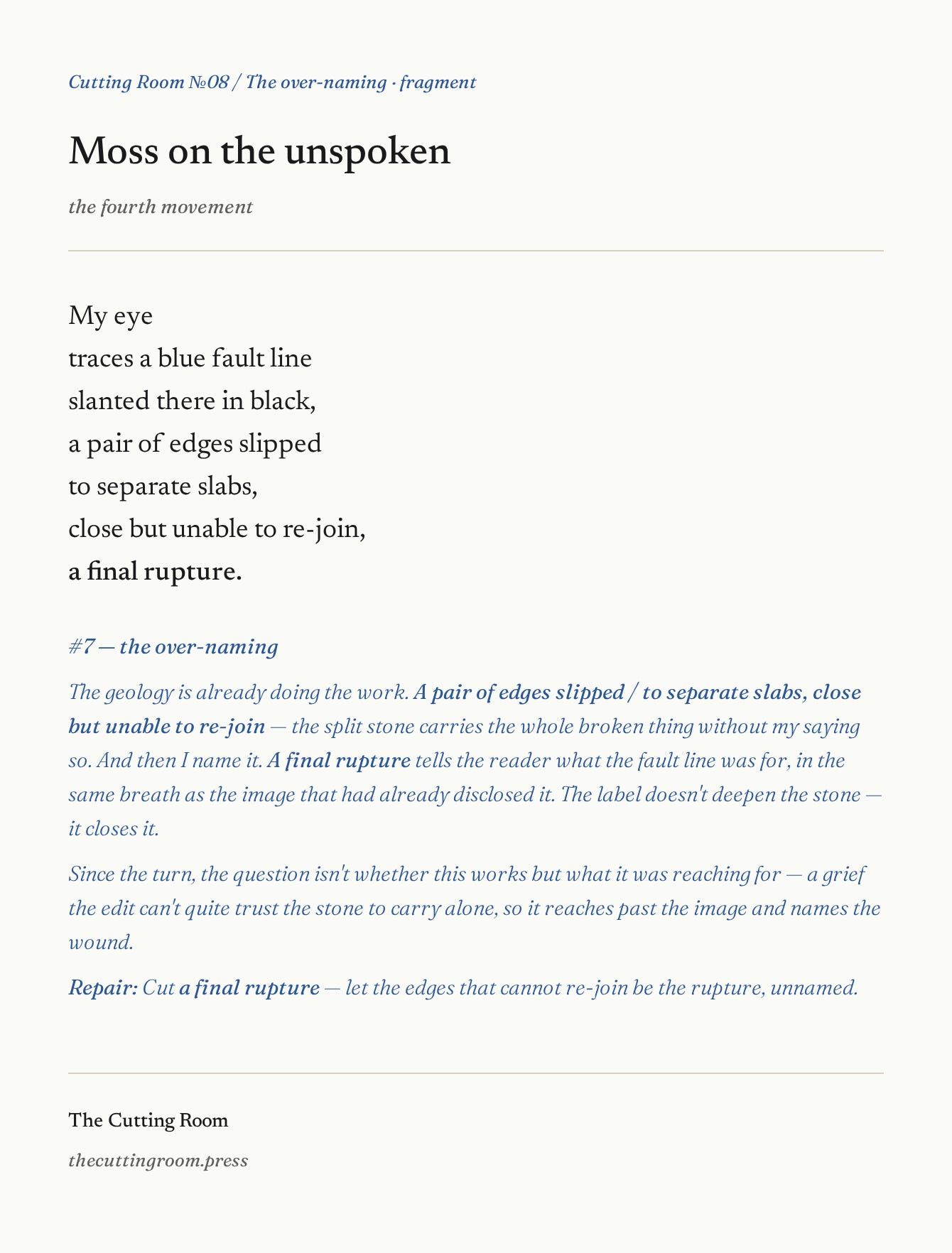
Seven lines, from the fourth movement of the draft:
My eye
traces a blue fault line
slanted there in black,
a pair of edges slipped
to separate slabs,
close but unable to re-join,
a final rupture.
The poem walks a long wood — rain held in the canopy, a quarry at the heart of it, moss taking the cut stone slowly back — and underneath the walk runs a failed closeness the speaker never names outright: words left unsaid, two people who couldn’t rejoin. The geology is the whole engine. A quarry face split along a fault, two slabs that were one rock and now sit a hand’s width apart for good. It is exactly the right image, and in this fragment it very nearly carries the poem’s whole grief on its own. Nearly — and the gap between nearly and wholly is the autopsy.
The autopsy.
Failures identified:
— #7 The over-naming
a pair of edges slipped
to separate slabs,
close but unable to re-join,
a final rupture.
The image has already done the disclosing. A pair of edges slipped to separate slabs, close but unable to re-join — a reader feels the broken thing without my naming it, because the split stone is the broken thing. And then I name it anyway. A final rupture arrives in the same breath and tells the reader what the fault line was for. The label doesn’t deepen the stone — it closes it.
What gets concealed, and the irony sits exactly here, is concealment itself — the Verborgenheit that would have kept the stone withholding something, so the reader goes back to look at it again. A final rupture forecloses that return. There is nothing left to find; I have found it for them, and handed it over.
Since the turn (mentioned above), I don’t stop at the fault. What was the line reaching for? A grief the edit couldn’t quite trust the stone to carry alone — so it reached past the image and named the wound, twice over, geology and heartbreak folded into one phrase. The reaching is the tell. The draft that trusts its image doesn’t append the meaning; the draft that doesn’t quite believe the stone will hold, does.
The repair. Cut a final rupture. End on close but unable to re-join, and let the edges be the rupture, unnamed.
Suggested revision. I’d make the single cut first and read the fragment aloud with the new ending. If close but unable to re-join feels too bare to close on, the fault isn’t that the label was needed — it’s that the line before it wants a little more weight to land the fall. Test the cut before you test anything larger. It’s one reversible action, and the later drafts already ran the experiment: by April, a final rupture was gone, and nothing collapsed.
What’s working. A pair of edges slipped / to separate slabs is the line I’d protect at all costs — it holds the geology and the two people in the same breath without conscripting either into metaphor, and leaves the reader to do the joining. Close but unable to re-join carries the whole unsayable thing in five plain words, the kind of line I trust precisely because it names nothing. Those I’m not touching. The cut frees them — it was the label crowding them out.
The general lesson. Two notes I’m taking from this one, and may keep coming back to. First: the over-naming rarely arrives as a wrong image — it arrives as a right image with its meaning stapled on, and the repair is almost never a new image, only the removal of the staple.
Second, and this is the fragment practice declaring itself: one line is enough to hold a failure mode up to the light. You don’t need the whole poem on the slab to see what it was reaching for — and the poem is better served staying whole, and mine, until it’s placed.
— Adam