

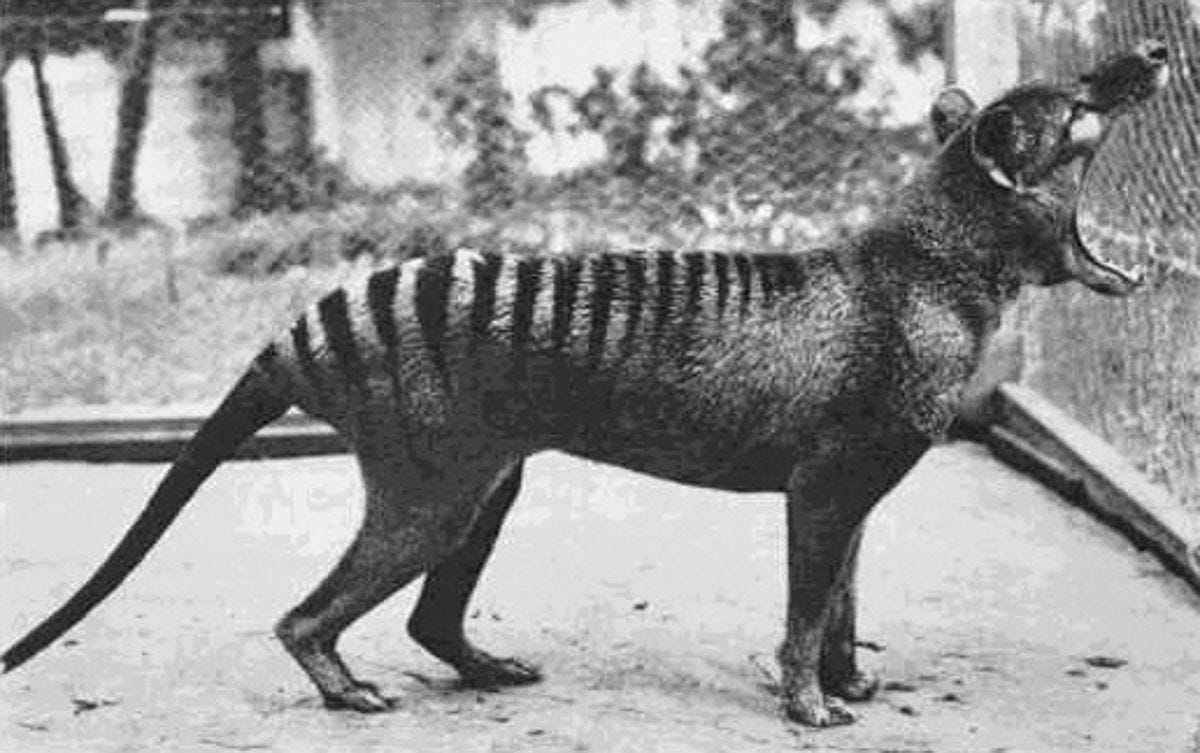
Tasmanian Tiger (Thylacine), Beaumaris Zoo, Hobart, Tasmania, 1933, David Howells Fleay
Most craft writing shows you a finished poem and asks you to admire it. The Cutting Room does the opposite — and the first draft on the slab is one of mine, a poem about an extinct animal that I undid with a single line of explanation.
The publication's working assumption — the spine I worked out in my draft pamphlet What Storms Disclose, after Heidegger's Aletheia — bad poetry conceals; good poetry discloses. Every failure mode I’ll name in these posts is a specific kind of non-disclosure — a way the poem produces the appearance of depth without the thing itself.
So. Here is the first draft on the slab.
The poem
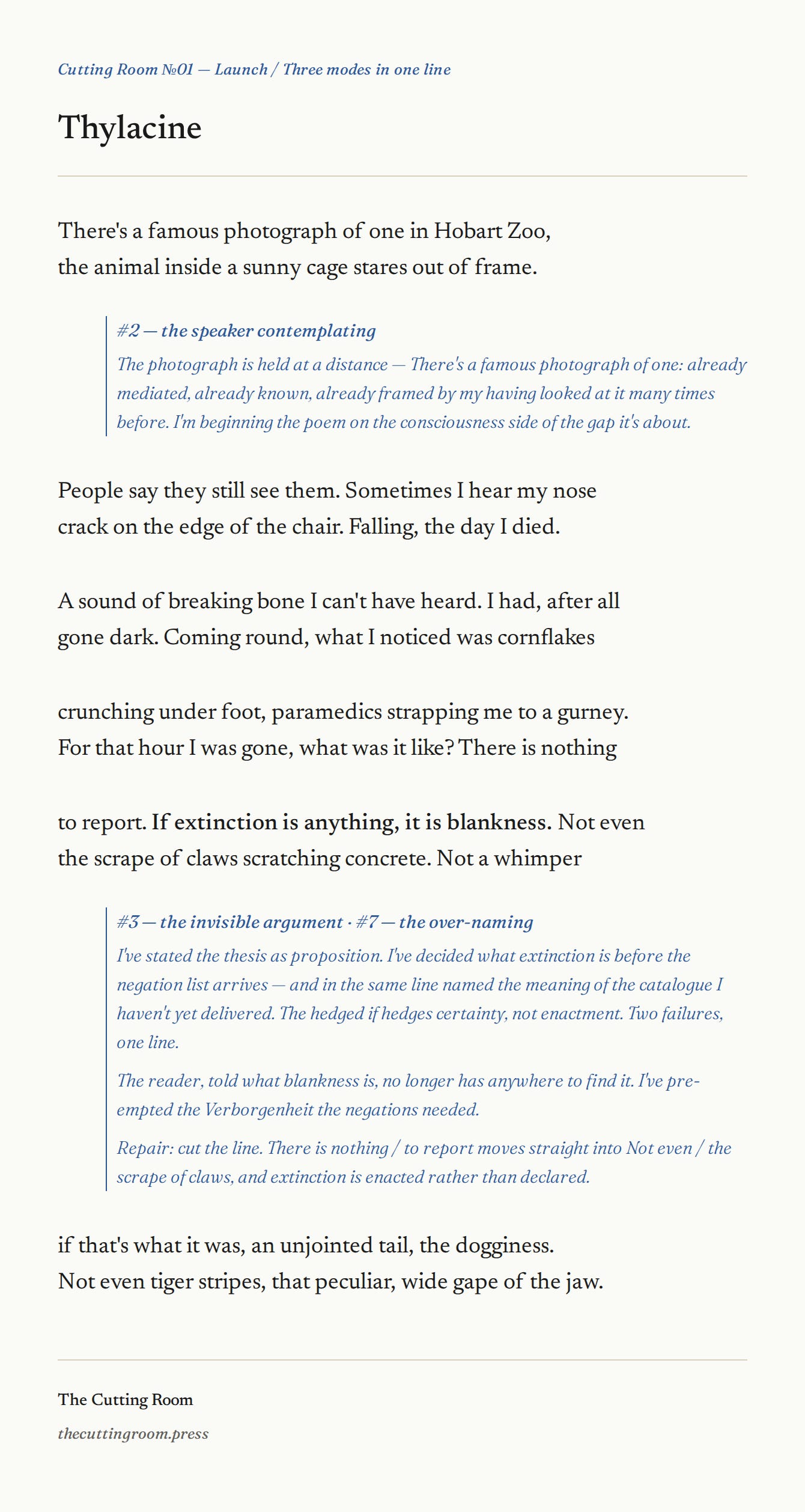
Thylacine
There’s a famous photograph of one in Hobart Zoo,
the animal inside a sunny cage stares out of frame.
People say they still see them. Sometimes I hear my nose
crack on the edge of the chair. Falling, the day I died.
A sound of breaking bone I can’t have heard. I had, after all
gone dark. Coming round, what I noticed was cornflakes
crunching under foot, paramedics strapping me to a gurney.
For that hour I was gone, what was it like? There is nothing
to report. If extinction is anything, it is blankness. Not even
the scrape of claws scratching concrete. Not a whimper
if that’s what it was, an unjointed tail, the dogginess.
Not even tiger stripes, that peculiar, wide gape of the jaw.
Twelve lines in six couplets. Two extinctions spliced together — the thylacine in the Beaumaris Zoo photograph, and the speaker’s hour of unconsciousness in his own kitchen — and the poem arriving at the proposition that both, finally, are the same thing: blankness.
It’s a poem I want to love. It has the cornflakes — bathos doing the work of disclosure, the return from death announced by breakfast cereal. It has a sound of breaking bone I can’t have heard, which is philosophically exact in five words: a memory that can’t be a memory. It has gone dark, which carries species extinction inside the smallest available phrase for personal blackout. And it has the structural pivot at Falling, the day I died — delivered without explanation, the swerve that the whole poem rests on.
But it doesn’t quite work. When I read the draft now, the reason it doesn’t quite work is sitting in a single line near the end — the line where I briefly stop trusting the poem’s own apparatus and start trusting the reader to take a piece of philosophy off me instead.
Failure Mode — #3 The invisible argument
If extinction is anything, it is blankness.
I read this line now and it’s the thesis stated as proposition. I’ve decided what extinction is before the negation list arrives. The line teaches rather than finds out. The hedged if hedges certainty, not enactment — the proposition still lands as a precept. The reader is being told the answer in the same breath as being asked the question.
The repair. Cut the line. I tested the poem without it: There is nothing / to report moves straight into Not even / the scrape of claws scratching concrete, and extinction is enacted by the negations rather than declared. If the negation list still lands, the thesis was redundant; if it collapses, the negations weren’t carrying their weight and the repair is somewhere else entirely. In my read it still lands. Better, in fact — the negations get more air.
Failure mode — #7 The over-naming
Same line, viewed from the side. By naming the meaning of the missing-thylacine catalogue before delivering it, I’ve closed the door I’ve just opened. The reader, told what blankness is, no longer has anywhere to find it. The Verborgenheit1 — the concealment that lets the negations build into their own conclusion — has been pre-empted.
The repair. The same cut. One line, two failure modes, single reversible action. The failure mode family map I’ve drawn predicts the convergence: failures of the reaching family and the disclosure mis-calibration family commonly cluster on a single line of premature naming.
Failure mode — #2 The speaker contemplating instead of acting
Look at the verbs across the whole poem. I hear. I had, after all / gone dark. What I noticed was. For that hour I was gone. There is nothing / to report. I’m delivering the verdict from after the event: contemplating the photograph from a distance, narrating the fall in retrospect, announcing the equation. I’ve already settled the identity between my own blackout and species extinction; I’m no longer at risk inside the poem.
The repair. Push myself, as the speaker, into the looking. The photograph in my hand or on the screen now. The somatic memory rising involuntarily now. The question what was it like? arriving as it actually does — without a settled answer waiting on the other side. The draft already half-contains this in Sometimes I hear my nose / crack — the present-tense involuntary memory the rest of the poem could be tuned to. The current frame, photograph → recall → thesis, has chosen to live on the consciousness side of the gap the poem is about.
Suggested order of revision. I’d address #3 and #7 first — same line, one reversible cut. If the poem strengthens without If extinction is anything, it is blankness, the family-root is fixed. Then test #2 experimentally: rewrite the opening couplet so the speaker is doing something with the photograph (looking at it now, turning it over, finding it somewhere) and see whether the rest of the poem redistributes its weight. The cornflakes and the sound of breaking bone I can’t have heard will hold under either treatment.
What’s working. The cornflakes under the paramedics’ boots is among the most converting particulars I’ve ever managed, and I’m not letting them go — domestic bathos as the return-route from extinction. A sound of breaking bone I can’t have heard is the philosophically exact phrase I’d want the rest of the poem to rest on, if the thesis line weren’t standing in front of it. Gone dark carries the species inside the person in two syllables — the kind of phrase I write and then can’t quite believe I wrote, which is usually the sign the poem found it rather than me. The pivot at Falling, the day I died is the structural move I’d build any version of this poem around. And the closing negation list (Not even ... not a whimper ... not even tiger stripes) is the apparatus I want, now, to let do its work — no longer guarded by the line standing in front of it. The cut frees them.
What this publication will do
That’s one autopsy. I’ll publish one a week. Same shape: a draft I’ve cut from a manuscript, or a poem of mine that almost works. The poem in full or a fragment. The failure named. The repair specified to this draft, not paraphrased from the entry.
The taxonomy is finite. There are roughly nine canonical failure modes (with eight finer-grained variants), grouped into five families: reaching, closure, disclosure mis-calibration, voice, and conversion. Each post diagnoses one cut draft by named mode. Over time the archive becomes a working clinic: same failures recur, repair patterns become recognisable, the editorial eye sharpens — mine and yours.
The first wave of posts, provisionally:
The abstraction reaching — the foundational failure: abstract language bypassing the concrete particulars that would have done the work.
The borrowed cadence — another poet’s register adopted without the necessity that earned it.
The easy resolution — the comforting ending the preceding lines haven’t earned.
The over-naming — the labelling that pre-empts the encounter.
The mechanical failure — length without weight; the pennies fall without a sound.
Today’s post triggered three modes at once, which is unusual. Most weeks I’ll be naming one.
Three things this is, and three it isn’t
It’s British, and of the Welsh Marches specifically. My diagnostic language carries the landscape and labour vocabulary of where I live and work; that grain will be visible. It’s diagnostic rather than aspirational — the autopsy register is the point. And it’s transparent about my own failures: the cuts come from my own drawer, by default, before they come from anyone else’s.
It isn’t a workshop. It isn’t a takedown of other poets — when a published poem is diagnosed here, it’ll be because the failure is instructive and the poet survives the cut. And it isn’t, finally, a list of stylistic preferences dressed as principles. The taxonomy is a tool. If it stops being useful, I’ll rewrite it.
The offer
Free for everything in the first three months — every weekly post, the full archive, the working taxonomy as it sharpens.
After that, a paid tier opens: possibly quarterly live workshops on a single failure mode, occasional manuscript mini-feedback (six lines, ruthlessly specific), and the full archive. Founding subscribers will get two single-poem deep edits at any point during their first year.
Free or paid, every Monday morning a draft will be on the slab. If the autopsy register suits you, subscribe.
— Adam
A word that may stop you: Verborgenheit. It’s Heidegger’s German — literally “concealedness” or “hiddenness” — and it earns its place here rather than being decoration.
Heidegger argued that truth (Aletheia, from the Greek) isn’t a fact waiting to be stated: it is an unconcealing, something that has to be drawn out of hiding. Things exist in a condition of concealment by default; disclosure is an event, not a property. That’s why the verb matters — truth happens, it isn’t simply there.
The Cutting Room borrows this structure directly. The central claim — bad poetry conceals; good poetry discloses — is Heideggerian in its bones. A poem fails, on this account, not because it’s wrong but because it prevents something from coming to light: it pre-names, over-explains, or settles the question before the reader has anywhere to find the answer themselves.
Verborgenheit appears in the diagnosis of failure mode #7 (the over-naming). When the poem states If extinction is anything, it is blankness before the negation list arrives, it performs an act of re-concealment: the meaning that the catalogue of missing details was supposed to enact — the reader arriving at blankness through the absence of claws, whimper, dogginess — gets foreclosed. Verborgenheit names the condition of productive hiddenness the poem has cancelled by speaking too soon.
In short: the Heideggerian vocabulary isn’t philosophical scaffolding for its own sake. It’s the most precise available language for what poems actually do when they fail — which is to close the door they’ve just opened.
I think this is excellent. It is one thing to have a nice theoretical framework. It is quite another to apply it.
Thanks, Adam. I've already axed a line in the current work in progress as a result of #7.
A very timely reminder.