
My two weakest lines, at the two places the form shows them most
No 2 — Dusk, dusk: the reach for the universal, twice, at the seams.


Last week I cut one line that carried three failures; this week the poem fails in only one way — but I committed it twice, and set both instances at the two seams of the form where a reader looks hardest: the close of the first stanza and the open of the second.
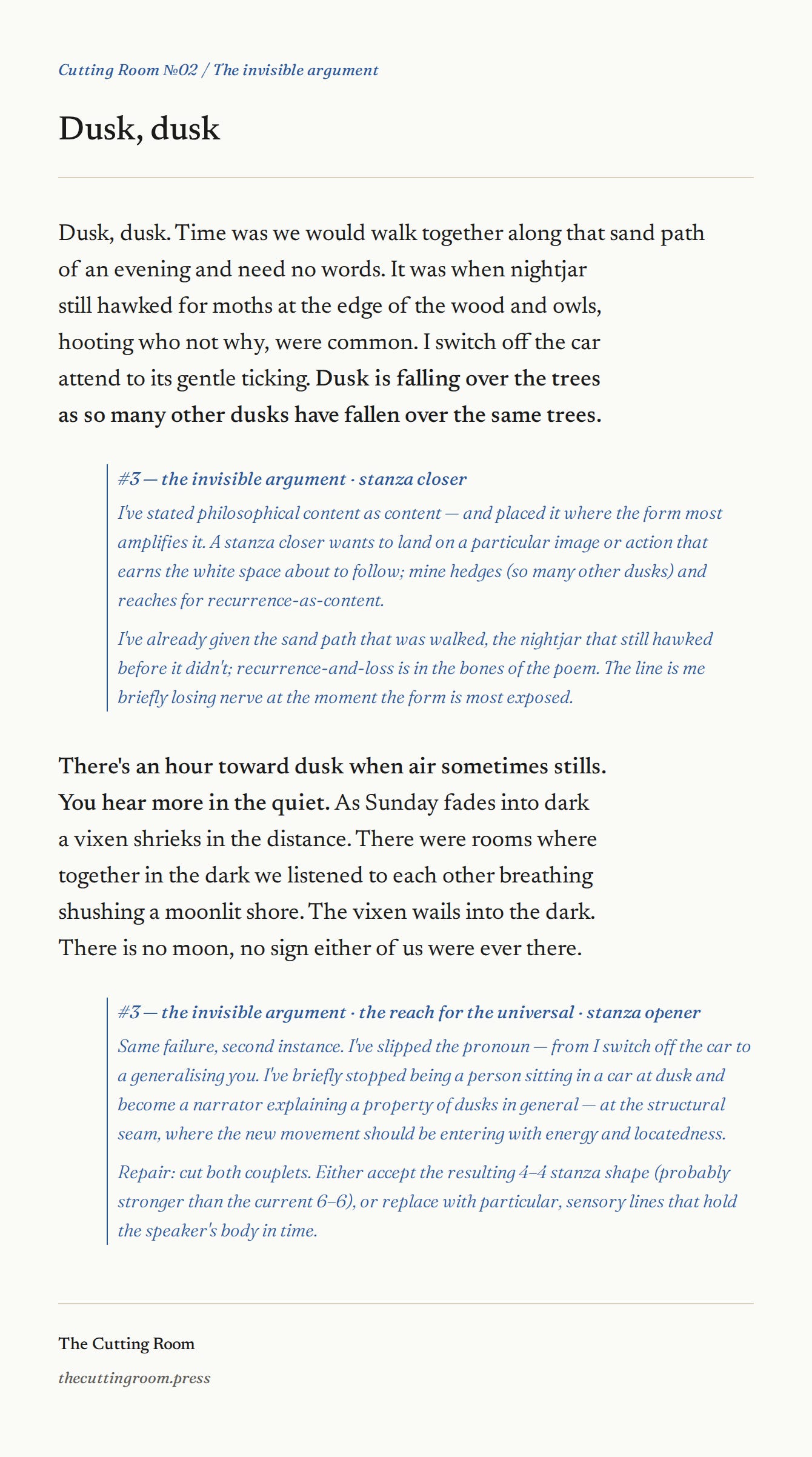
The poem
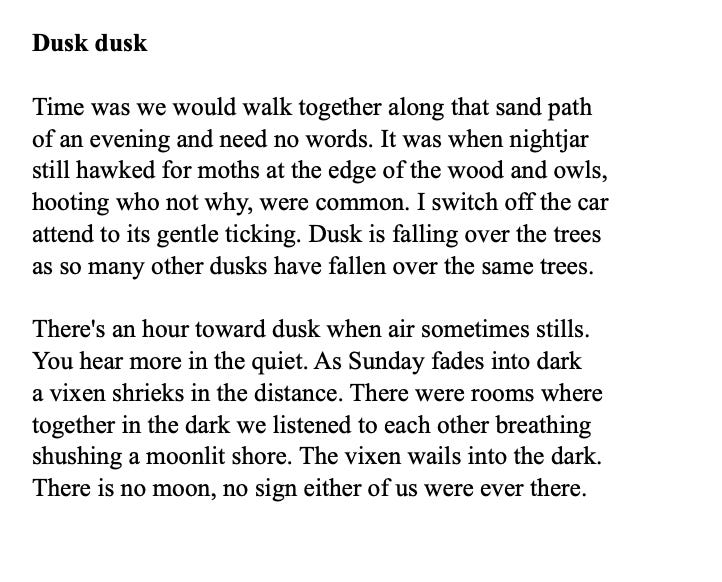
Twelve long lines in two six-line stanzas, gentle rhymes. I’m arriving at a place I used to walk to with someone, switching off the engine, listening to the dusk, hearing a vixen, remembering rooms, hearing the vixen again, and registering the absence of the moon and of any trace of either of us. The poem mostly knows what to do. The fauna are in the right tense — nightjar / still hawked, owls ... were common — and the ecological vanishing runs as a faint counter-melody beneath the personal vanishing. The vixen’s shriek-into-wail does honest work; the moonlit shore arrives as an unexpected inset of intimacy, then the close strips it back. Hooting who not why is the kind of small bright joke I’ll forgive a poem for, even my own.
What it doesn’t quite do — and the reason I’ve twice cut it from draft collections that didn’t quite need it, then twice put it back — is trust its own apparatus all the way through. The structural placement of where it stops trusting is the part the autopsy adds.
The autopsy
Failure identified:
— #3 The invisible argument (sub-case: the reach for the universal)
The closing couplet of stanza one:
Dusk is falling over the trees
as so many other dusks have fallen over the same trees.
And the opening couplet of stanza two:
There’s an hour toward dusk when air sometimes stills.
You hear more in the quiet.
Same failure — stating philosophical content rather than enacting it — appearing twice. I’ve put both instances at the two positions where stanzaic verse most rewards specificity: the closer and the opener. A stanza closer wants to land on a particular image or action that earns the white space about to follow. A stanza opener wants to enter the new movement with energy and locatedness. Neither does. The closer hedges (so many other dusks); I can hear it reaching for recurrence-as-content rather than producing it. The opener slips the pronoun — from I switch off the car to a generalising you — the reach for the universal sub-case — and I notice myself, as the writer, briefly turning into a narrator explaining a property of dusks in general.
The two thesis lines bracket the stanza break. I’m using the poem’s structural pivot — the place where the form most clearly performs its movement — to carry declaration rather than particular noticing. I’m telling the reader what the dusk is, twice, in the two positions where I could most powerfully have shown it.
What I conceal, in those two couplets, is what the rest of the poem otherwise discloses well: that the quietness, the air stilling, the recurrence of dusks over a place — all of these belong to this particular dusk, this car, this absent companion. Generalising them shrinks them. The hedge in so many other dusks is the giveaway; the you in You hear more in the quiet is the second.
The repair. Cut both couplets. What I’d be left with is two shorter and less balanced stanzas — which may or may not be what I want.
If formal symmetry matters to me, the cuts ask for replacement lines, not pure excision. Stanza one could close on the speaker’s body still in the act of arriving: a hand on the wheel, the dashboard going dark, the way the windscreen cools. Stanza two could open on the same body, the same attention, particular: something settling in the engine. The seat-belt warming the back of my neck. The poem’s apparatus is sensory and accurate when it trusts itself; the repair is to extend that trust through the structural pivot.
If formal symmetry doesn’t matter, the unequal stanzas are themselves the formal choice. A four-line stanza closing on attend to its gentle ticking — the ticking engine as the last sound before silence — then a stanza break, then As Sunday fades into dark / a vixen shrieks in the distance as the new movement’s first noise. That’s a stronger poem than the current draft, by some distance. The asymmetry would do work the symmetry currently isn’t doing.
Suggested order of revision. The two cuts are independent and reversible. I’d cut the stanza-one closer first; sit with the four-line stanza for an hour. If the lopsided shape feels right, cut the stanza-two opener too and I have my eight-line poem. If the shape feels wrong, write the two replacement couplets — particular, sensory, in the speaker’s body — and I have my twelve-line poem.
What’s working. Hooting who not why is the joke I keep coming back to; it earns its place. The fauna held in past-perfect (still hawked, were common) keep the ecological note running under the elegy without ever stating itself as ecology — I want all of that protected. The structural pivot at There were rooms where / together in the dark we listened to each other breathing / shushing a moonlit shore is the only fully present sensual image in the collection’s wake, and the shushing is doing more work than its three syllables suggest — sea-on-shore, breath, hush all in one. I’m not touching that one. And the close (no moon, no sign either of us were ever there) is the chiastic arrival the poem has been building. The cuts don’t reach it.
The general lesson
The reach for the universal is a small, common, deceptively gentle failure. It almost always looks like the poet being generous to the reader — here, let me show you what the dusk is. The cost is that the gift is the wrong gift. What the reader wanted was the dusk; what they got was the dusk explained.
Two notes I’m taking from this autopsy, and may keep coming back to. First: where a thesis line sits in the form matters as much as that it’s there. A generalisation hidden in the middle of a stanza does less damage than the same generalisation at a closer or an opener, where the form is amplifying it. I’m going to read drafts at the structural seams from now on — the line before the white space, the line after — which catches more of this kind of failure than a left-to-right read does. Second: the repair often isn’t deletion but particularisation. The lines don’t need to go because they’re long; they need to go because they’re general. Replacing them with shorter, less literary, more located lines tends to be the move.
— Adam
Another very interesting autopsy. You say the invisible argument is an attempted if unneeded gift to the reader. I wonder if it is more of a reassurance to the writer that they are on to something. Organs to be removed for further examination perhaps