
The comfort arrived before the grief did
No 4 — Little lady of Flores: consolation the poem hadn't earned.

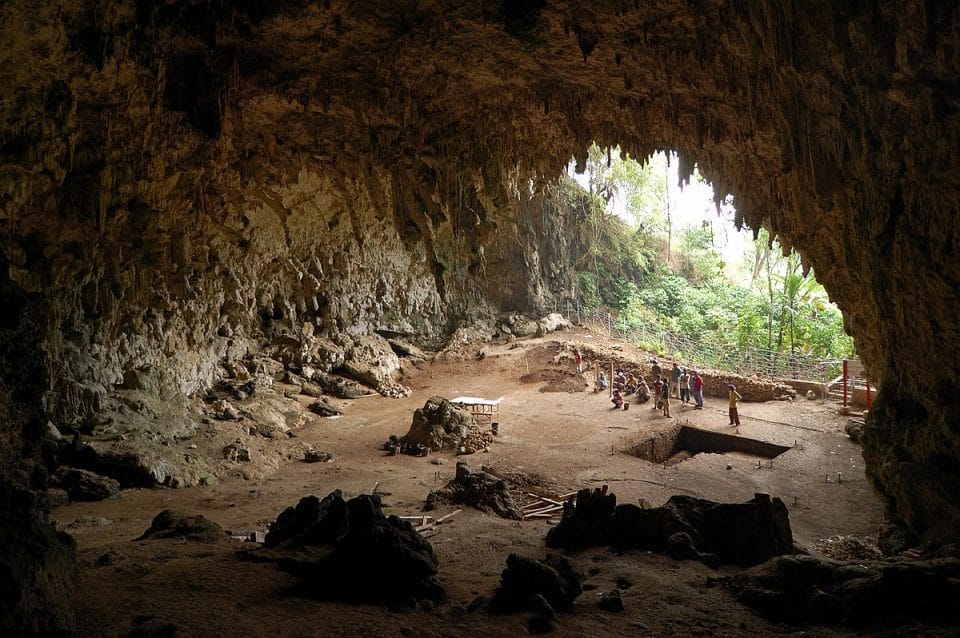
Lang Bua cave - Flores, Indonesia
By the second stanza the poem is already consoling me, and the loss it means to console has not yet landed — I have offered the reader comfort for a grief the draft never made them feel. I mourned a species before the poem had buried it.
This is a sibling poem to Baiji (I’m holding this one back for now) and Thylacine — the third extinction draft in the drawer, the one that didn’t make the What Storms Disclose (a draft pamphlet) selection. Worth putting on the slab partly to see what kept it off the boat.
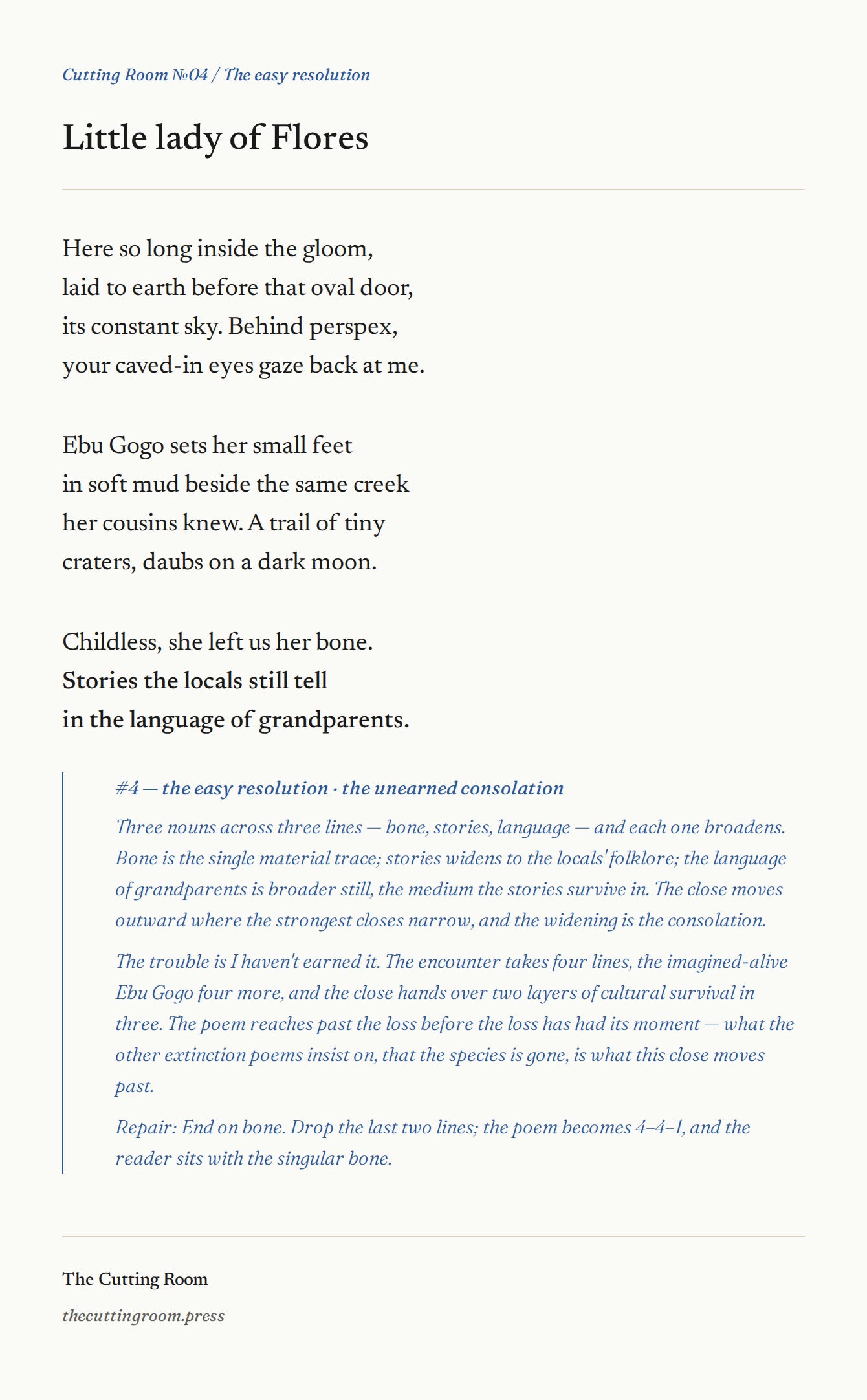
The poem
Little lady of Flores
Here so long inside the gloom,
laid to earth before that oval door,
its constant sky. Behind perspex,
your caved-in eyes gaze back at me.
Ebu Gogo sets her small feet
in soft mud beside the same creek
her cousins knew. A trail of tiny
craters, daubs on a dark moon.
Childless, she left us her bone.
Stories the locals still tell
in the language of grandparents.
Eleven lines in 4–4–3. I’m standing at a museum case looking at the Homo floresiensis skeleton — Ebu Gogo, the small wild people of Indonesian folklore the locals on Flores claim to have seen in the forest. I read the case label, meet the skeleton’s gaze through perspex, imagine her alive at a creek with her cousins, register her small footprints in mud as craters on a dark moon, and arrive at the close: childless, she left us her bone, and stories, and the language those stories live in.
The structure is honest about its plan — encounter, empathy, residue — and the individual moves are strong. Laid to earth before that oval door, / its constant sky does double duty (the cave mouth, the case opening, the eye socket itself). Your caved-in eyes gaze back at me is the meeting-of-gazes line the museum encounter wants. A trail of tiny / craters, daubs on a dark moon is the best image in the poem — the smallness of her footprints redoubled as cosmic geometry.
What it doesn’t quite do — and the reason it didn’t make the cut — is sit with the species’ absence before it offers what survives.
It’s also relevant to note this poem has been around a long time and it has endured many separate attempts at resuscitation. At this stage, it may in truth have been cut too hard.
The autopsy
Failure identified:
— #4 The easy resolution (sub-case: the unearned consolation)
The closing tercet:
Childless, she left us her bone.
Stories the locals still tell
in the language of grandparents.
Three nouns across three lines: bone, stories, language. Each line broadens. Bone is material, particular, singular — one bone left from a species that disappeared. Stories is plural, collective, cultural — the locals’ folklore. Language is the broadest layer yet — not even the stories themselves but the medium they survive in, the grandparents’ language carrying them forward.
Compare the shape of this close to the another extinction poem in the drawer. Thylacine narrows: not even the scrape of claws → not a whimper → not even tiger stripes → the wide gape of the jaw. The poem closes inward, down to the one specific physical detail.
Little lady of Flores closes the other way. It broadens outward: physical residue → cultural memory → the language those memories live in. The widening is the consolation. By the time I arrive at the language of grandparents, I’ve moved the reader two steps away from the perspex case and the caved-in eyes. The species is gone, the line says, but its trace persists across generations of speech. The reader is reassured.
The trouble is that I haven’t earned the reassurance. The encounter with the case takes four lines; the imagined-alive Ebu Gogo takes four more; the close offers two layers of cultural survival in three lines. The ratio is wrong. The poem reaches past the loss before the loss has had its full moment.
What I conceal is what the other two extinction poems insist on disclosing: that the species is gone. Thylacine names blankness (and, last week, I diagnosed the line that names it too declaratively — different problem, same family of restraint). Little lady of Flores moves past the absence to the consolations it can offer the living.
The repair. End on bone.
The cleanest cut: drop lines 10 and 11. The poem becomes 4–4–1, with the closing single-line stanza doing the work that the current three-line tercet diffuses. Childless, she left us her bone. Then the white space. Then nothing. The reader sits with the singular bone.
If the asymmetric 4–4–1 feels too clipped, the alternative repair is to leave bone as the close and find the cultural-memory material a different home — perhaps as the opening of the poem rather than the closing. Stories the locals still tell / in the language of grandparents could be the introduction to Ebu Gogo: the folkloric Ebu Gogo before the museum-case Ebu Gogo, the imagined alive before the dead. The poem would move from the local stories → the museum case → what is actually left (bone). That inverts the consolation problem: the cultural-memory frame becomes a setup the encounter then disturbs, rather than a reassurance the encounter then receives.
Suggested order of revision. I’d try the simplest cut first — drop the last two lines, sit with the 4–4–1 version for an hour. If the close feels too steep, try the structural inversion (stories at the top, bone at the bottom). If neither works, the third option is to keep the current structure but make the language of grandparents darker — find one specific local detail that complicates rather than consoles. A particular story about Ebu Gogo that’s not benign. A grandparent’s word the speaker doesn’t understand.
What’s working. Laid to earth before that oval door, / its constant sky is the line I’d protect at all costs — three things at once (cave mouth, case opening, eye socket) without ever naming the doubling. Your caved-in eyes gaze back at me is the meeting-of-gazes line the museum elegy genre is constantly reaching for; most fail because they let the speaker do the gazing, where this version makes the dead do it back. A trail of tiny / craters, daubs on a dark moon is the kind of image I write and have to be careful not to lose. Childless, she left us her bone — the line the repair builds on — is the strongest declarative in the poem, and the singular bone is doing all the work I want the poem to land on. None of these are at risk from the proposed cut. The opposite: the cut gives them the space to land.
The general lesson
The easy resolution lives most often at the close — which is why every editorial pass should read the last stanza twice, once for what it says and once for the shape of how it says it. Two questions worth asking of any closing tercet, quatrain, or coda:
First: does the close narrow or broaden? The strongest closes I know narrow — they move from the general toward a single particular that has accumulated weight across the poem and now has nowhere else to go. Closes that broaden, that move from particular to general or from material to abstract, almost always lift the reader away from the specific occasion before the occasion has fully delivered. There are exceptions (e.g. Larkin’s High Windows); the rule is worth knowing as a default.
Second: is the consolation in the poem, or in the form? A closing image that names cultural persistence, or seasonal return, or shared humanity, is often the form of consolation performing itself — the closing tercet doing what closing tercets are conventionally for. The honest question is whether the speaker, in this specific encounter, has earned the consolation the form is offering. If the form is doing the work the speaker hasn’t, the close belongs to the genre rather than to this poem.
— Adam