
The hand was on cold rock — then the speaker stepped out of the weather to explain
No 3 — Again: the speaker who contemplates instead of climbs.

The poem has its hand on cold rock — wet, particular, present — and then, a line later, the speaker climbs down off the rock face to report a thing he says he has always known; the looking stops, the contemplation begins, and the poem leaves the weather it was made of.
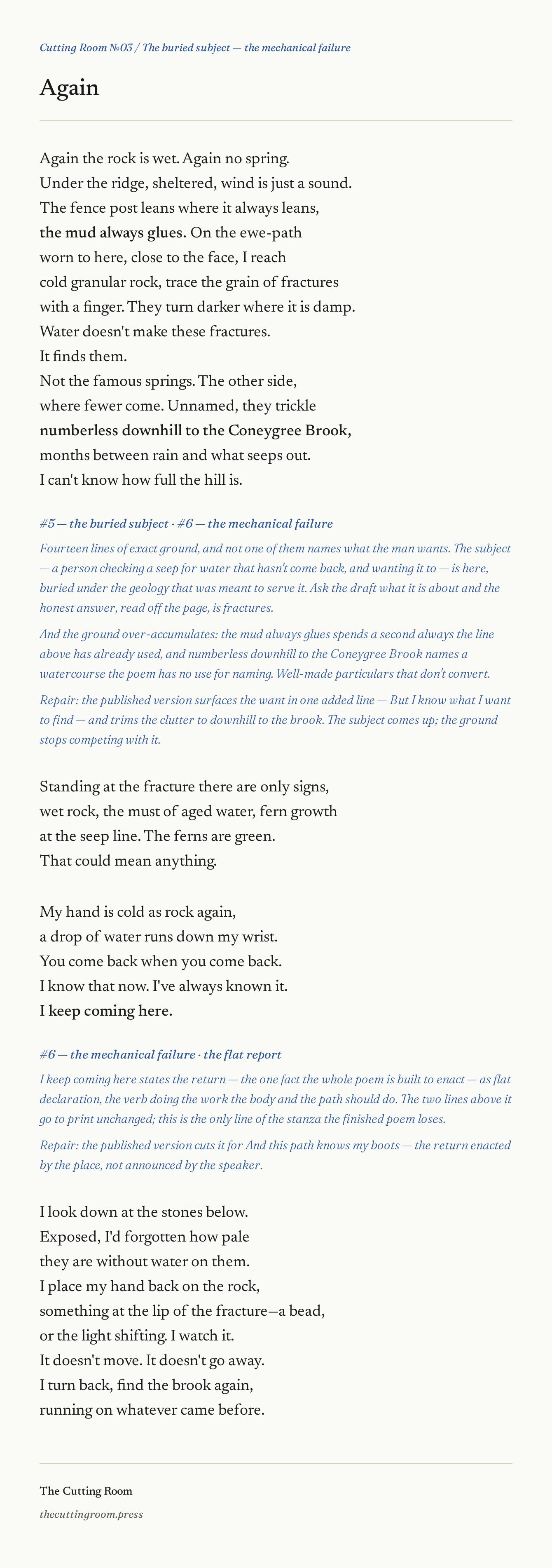
Again came back from the drawer this spring and has just been published, which means the draft underneath it can go on the slab whole. Thirty-two lines, four stanzas — the early version, a man at a dry seep checking a spring that hasn’t come.
The poem knows its ground. The geology is real, observed, never reached-for — water finds the fractures rather than making them, the springs run on the quiet side where fewer come, the ferns are green and that could mean anything. And the subject is genuinely there: a man checking a seep for water that hasn’t come, again. The title carries it; the first two lines — Again the rock is wet. Again no spring — carry it. The trouble is everything between those two lines and the close keeps the man’s stake out of sight, under the rock he is describing so well.
The autopsy
Failures identified:
— #5 The buried subject
Again the rock is wet. Again no spring. … I can’t know how full the hill is.
The opening fourteen-line stanza runs from the first line to the springs without once naming what the man wants. The nearest the draft comes is the oblique I can’t know how full the hill is — and that is a fact about the hill, not a want about the man. I’ve built the ground in exact detail and left the reason for standing on it off the page. The subject — a person checking a seep for something that hasn’t come back, and wanting it to — is in the poem, but buried under the geology that was meant to serve it. Ask the draft what it is about and the honest answer, read off the page, is fractures.
What’s concealed is the destination: what the man wants, and why the return matters. The reader has the infrastructure — line, image, the worn ewe-path — and nowhere it delivers them.
The repair. The published version surfaces the spine twice, and adds almost nothing to do it. After the springs it adds a single line — But I know what I want to find — naming the want without naming the thing. And it changes the flat they are without water on them to they are when the spring fails, letting the closing image carry the failure the whole poem is about. One line added, one phrase sharpened, and the subject comes up out of the ground.
— #6 The mechanical failure
numberless downhill to the Coneygree Brook … the mud always glues … the must of aged water … I keep coming here.
Well-made particulars that don’t convert. numberless inflates, and the Coneygree Brook names a watercourse the poem has no use for naming; the mud always glues spends a second always the line above it has already spent; I keep coming here states the return — the one fact the whole poem is built to enact — as flat report. Each is defensible on its own. Together they are length without weight: the pennies fall and the hill stays silent.
What’s concealed is the reckoning. The particulars accumulate without gripping onto the man’s stake, because the stake — see above — hasn’t surfaced yet for them to grip.
The repair. The published version trims each. downhill to the brook loses the name and the inflation; the mud always glues compresses to a bare Mud.; aged becomes old; and I keep coming here becomes And this path knows my boots — the return enacted by the body and the place rather than announced.
Suggested order of revision. I’d surface the spine before touching anything else. Add the want — one line that says what the man is there for — and most of the over-accumulated geology becomes cuttable on sight, because the particulars that don’t serve the now-visible subject fall away on their own. The buried subject is the root; the mechanical clutter is half a consequence of it. If you cut first, you spend an afternoon deciding which good details to lose and never find the one detail that would have told you. Surface, then cut.
What’s working. Two lines went to print unchanged, and they are the ones a quick diagnosis would have reached for first. You come back when you come back and I know that now. I’ve always known it — a proverb and a flat admission of long knowing, the kind of pair that usually forecloses a poem’s discovery before it can happen. They survive because the body holds around them: the published version keeps them pinned between the present-tense hand — a drop of water runs down my wrist / from the rock or from the air, / I can’t tell — and the path that does the recognising. Held that way, the proverb is earned rather than announced. I’m not touching those. And the bead at the lip of the fracture — It doesn’t move. It doesn’t go away — survives whole, the poem’s cleanest disclosure, the line I’d protect at all costs.
The general lesson
Two notes I’m taking from this autopsy.
First: a buried subject is diagnosed by absence, not by a bad line. You find it by asking what the poem is about and failing to answer from the page — every line is well made, and not one of them is the culprit. The repair is rarely a cut; it is a surfacing. One added line that names the want can do more than ten cuts, because once the subject is visible every other line can be measured against it, and the clutter names itself.
Second — and this one is about method. The slab only holds what the finished poem moved. A line that survives from draft to print is, by definition, not the failure — diagnose it and you are autopsying a living patient. The discipline is to read the draft against the published version and let the cuts tell you where the body actually was. The lines I marked here are the ones the poem itself decided to lose; the lines I left are the ones it kept, and I have no standing to put those on the slab.
If you would like to read the poem (post repair) as it was published you can do so here. Thanks to Helen Ivory | poet | artist and Zakia Carpenter-Hall for publishing it all the great work they do over at Ink Sweat and Tears.
— Adam