

Two tercets in, the poem is climbing in borrowed boots — the rising three-line music of the mountain-poem — and the cadence has already decided what the climb means before the climb has happened.
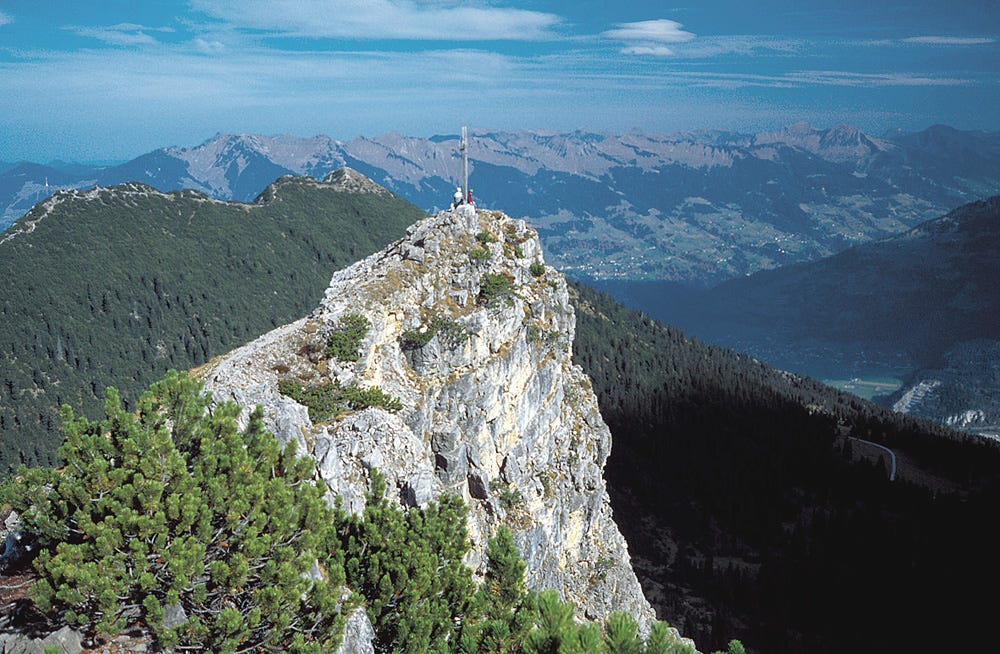
The Schillerkopf - courtesy of outdooractive.com
Here is a fragment from a ten-tercet ascent poem set in the Austrian Alps, drafted in March and cut from What Storms Disclose during the spring selection. Two tercets at the structural summit, the moment the poem arrives where it has been climbing to. The cadence I’ve reached for is generic mountain-spiritual — the register that runs from the Cold Mountain translations through Snyder’s Riprap to the Bergpoesie I’d half-absorbed reading Heidegger on Hölderlin. The register is older than any one exemplar; it is the inherited shorthand for mountain poem. I haven’t earned it.
The fragment
Narrow summit and cross
leaned against the wind,
clean air, crisp and clear,
silence working hard.
Sweat on our back cools.
We come fully alive.
Two tercets from the middle of a ten-tercet poem — lines 13 to 18 of 30. The speaker reaches a limestone ridge in the Austrian Alps; these are the lines where the summit is named and inhabited. The village below, the descent, and the return stay in the drawer.
The autopsy
— #8 The borrowed cadence
clean air, crisp and clear, // silence working hard. / Sweat on our back cools. / We come fully alive.
I’ve reached for the register before earning it. The articles drop out — clean air, not the clean air; Sweat on our back cools, not the sweat. The adjectives line up in plain Anglo-Saxon monosyllables — clean, crisp, clear. The abstraction is asked to do physical work — silence working hard. And the closing line of the second tercet announces the summit epiphany in three monosyllables and an adverb — We come fully alive — the mountain-poem arrival at its most generic.
What’s borrowed is the cadence of mountain-spiritual poetry as a tradition. Snyder’s Riprap voice. Han Shan in Snyder’s translation. R.S. Thomas on a Welsh hillside. The Bergpoesie I’d half-absorbed reading Heidegger on Hölderlin. No single poet is being copied; what’s being copied is the register — the inherited “this is how altitude sounds in English-language poetry”. The register is doing the work the body and the rock should have done.
The diagnostic test for borrowed cadence: ask what specific necessity made the original poet need the register. Snyder’s compression was earned on logging crews and trail repair — his sentences were short because his life with words was. Han Shan’s gnomic declarative was earned by twenty years on a mountain. Thomas’s plain register was earned by parish ministry on hard ground. This draft was a hiking week from a summer gasthaus. The specific necessity that earned the register for the original poets isn’t in this poem. So the register sits on top of the lines as decoration — and decoration always reads as decoration.
The repair. Lose the register entirely, then find the voice this particular climb, this particular morning, would have spoken in. Not the harder work of a craft repair. The harder work of asking what these two bodies, on that ridge, at that hour, would have said in a voice that didn’t already know what mountain poems sound like.
The general lesson
Two notes I’m taking from this autopsy, both about how cadence is inherited.
First: a borrowed cadence often arrives alongside the subject. Climb a mountain in a poem and the voice of every other mountain poem comes with it. The register is so available, so well-formed by a century of English-language practice, that it speaks itself before the writer has noticed. The diagnostic check is to ask whether the cadence of one’s draft would survive being relocated. If the same lines could sit in a Snyder volume, in a Cold Mountain version, in a Bergpoesie anthology, the cadence isn’t yet one’s own.
Second: the borrowed register often hides where the encounter should have been. We come fully alive is the line where the cadence speaks loudest, and it is also the line where the poem skips the encounter. What did being on that ridge actually do? The register makes the question feel answered. It isn’t. The line below the borrowed phrase is usually the one the draft was reaching past — the same diagnostic shape as last week’s Prayers, with the register doing the work the feeling-noun did there.
— Adam