
One noun too many, and the rest of the poem stays in the drawer
No 5 — The knackerman: over-naming in two lines.

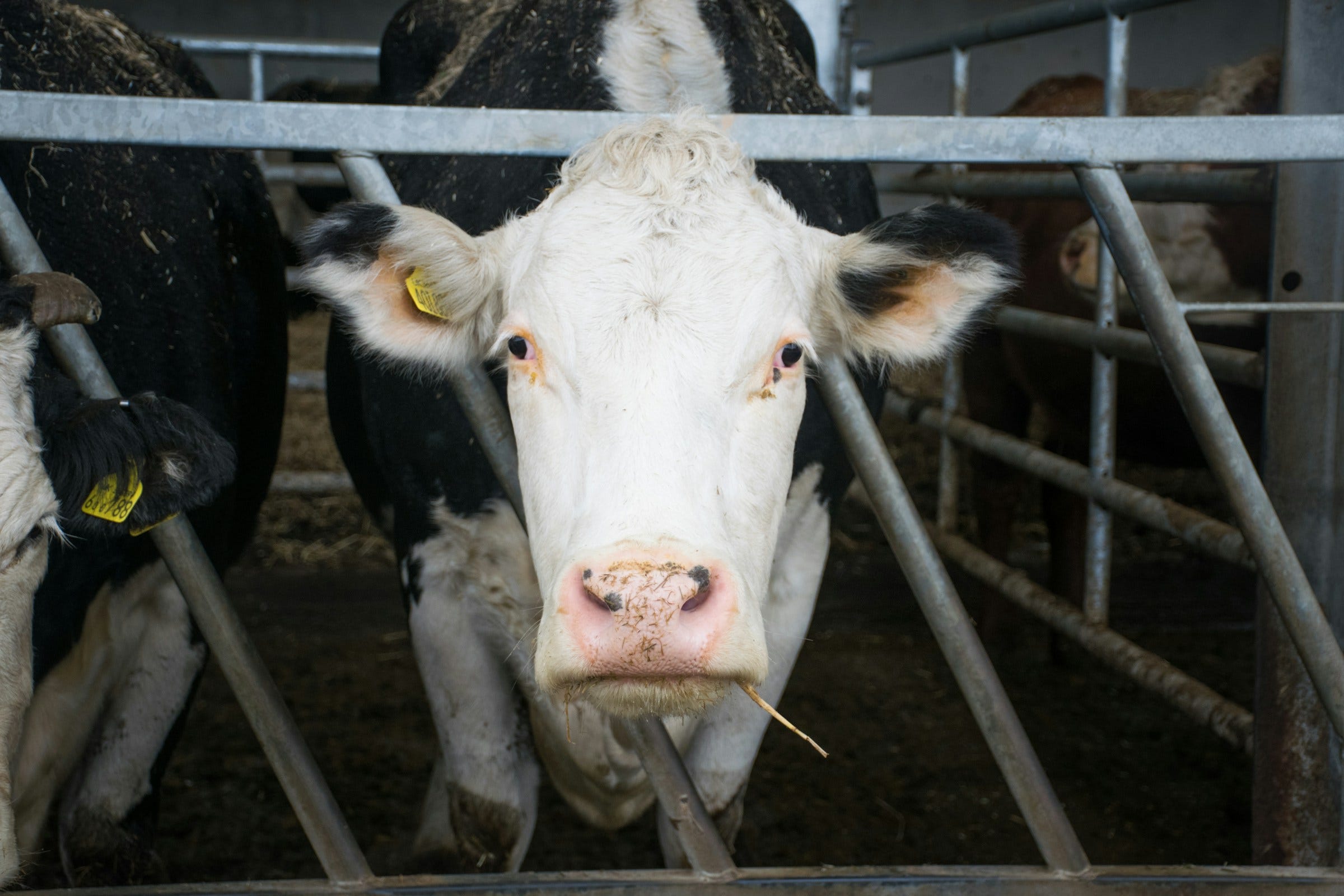
Photo by Veronica White on Unsplash
Two lines in, there is a noun I should never have written down — the word that names the thing the poem was about to show me — and because it is there, the other lines have stayed in the drawer.
The fragment
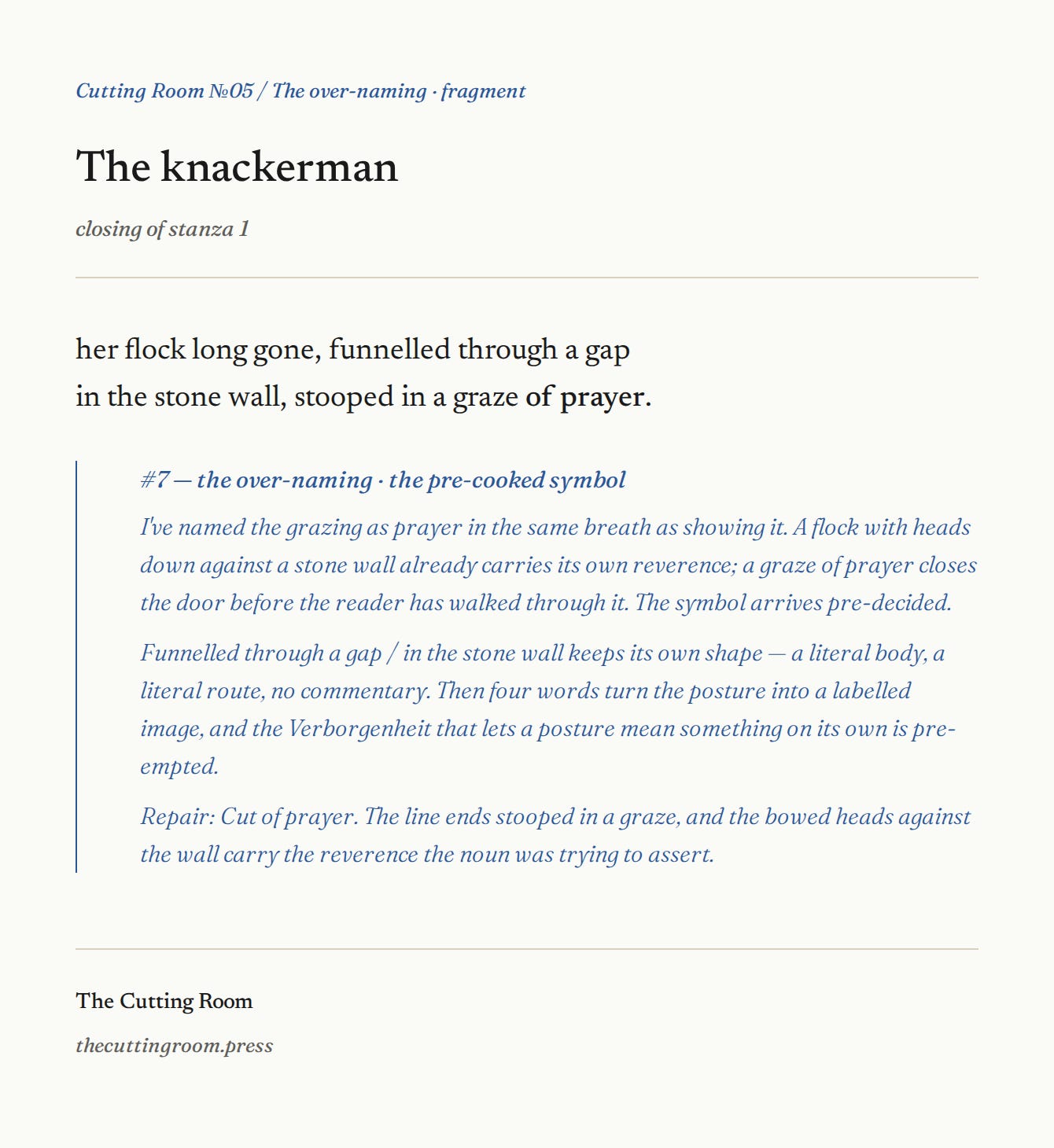
her flock long gone, funnelled through a gap / in the stone wall, stooped in a graze of prayer.
The closing two lines of the first stanza of a four-stanza poem about a knackerman — the man who collects dead and dying livestock from surrounding farms. The opening stanza arrives at a downed ewe in a wind-scuffed field; these two lines describe the rest of her flock, gone through a gap in the wall, grazing somewhere just out of sight. The poem itself stays in the drawer for further revision; the cut is on these two lines only.
The autopsy
— #7 The over-naming (sub-case: the pre-cooked symbol)
I’ve named the grazing as prayer in the same breath as showing it. The bowed-head posture of a flock against a stone wall already carries its own reverence — a flock with heads down, en masse, is already a religious figure for anyone who has stood near sheep at the edge of a field. A graze of prayer closes the door before the reader has walked through it. The symbol arrives pre-decided, and the image becomes the carrier of a meaning I’ve already settled.
The diagnostic is sharpened by what the same fragment does well. Funnelled through a gap / in the stone wall keeps its own shape — the sheep have a literal body and a literal route, and the line earns the reader’s attention by withholding any commentary. Then the closing four words turn that resulting grazing posture into a labelled image, and the labour the line has just done is collapsed into a religious noun.
The Verborgenheit — the concealment that lets a posture mean something the reader can find on her own — is exactly what’s been pre-empted. Once the meaning is named, there’s nothing left for the reader to bring to the image. The image stops disclosing.
The repair. Cut of prayer. The line ends stooped in a graze, and the bowed-head posture, against the wall, carries the reverence the noun was trying to assert. If the resonance survives the cut, the noun was redundant. If the resonance disappears, the image wasn’t earning it and the repair is somewhere else entirely — but in this case it survives, sharper for being unnamed.
Why fragments
Two reasons. The pragmatic one: Substack posts count as publication for almost every serious poetry journal, and at fifty-two whole drafts a year I’d empty the cellar within two or three. Some of the drafts I’d autopsy on this Substack are poems I might revive and rework — and posting the whole draft now closes that door. A fragment is a specimen of the failure, not the publication of the poem. The four stanzas around the two lines above stay in the drawer.
The diagnostic one: most of the failure modes operate at the unit level, not the whole-poem level. A single line of over-naming, an opening that performs feeling, a stanza closer that reaches for the universal — these are diagnosable in two to eight lines. The whole-poem autopsies of the launch wave were the right move for establishing the taxonomy through confessional case-work; once the taxonomy is in place, the smaller specimen does the same diagnostic work, sometimes more cleanly because the failure isn’t obscured by the surviving strengths around it.
Whole-poem autopsies will still appear when a draft genuinely justifies the whole-draft treatment — interrelated failure modes, or a structural shape that’s itself part of the diagnosis. But the steady-state register from now is fragment: one mode, the smallest legible specimen, the repair, and the general lesson.
The general lesson
Two notes I’m taking from this autopsy, both about the moment when a noun steps in front of the image it’s labelling.
First: the religious-noun test. When a religious word arrives in a poem — prayer, grace, blessing, communion, vigil, psalm — pause and ask whether it is being earned by what the surrounding image actually shows, or asserted in lieu of the image showing it. In nine cases out of ten the religious noun is the giveaway: the poet has seen something that resonates with reverence and named the resonance instead of trusting the image to produce it. The repair is almost always the same. Cut the religious noun. Leave the image. See whether the reverence survives. If it doesn’t, the image wasn’t doing what the noun was claiming.
Second: the fragment as diagnostic. A failure that survives across a fifty-line poem is rarely diagnosable from the whole poem — too much else is going on, and the failure can hide behind its neighbours. A failure that’s visible in two lines is visible in two lines because the failure is in the two lines. The discipline of selecting the smallest specimen that demonstrates the mode is itself a sharpening of the editorial eye: if the cut doesn’t work in two lines, the diagnosis is wrong, not the fragment.
— Adam
Every Monday, a new draft goes on the slab. If you find this diagnostic approach useful for your own work, consider subscribing to receive the weekly autopsy in your inbox. If you know another writer currently wrestling with a difficult draft, please share this post with them.
Ouch. Been there. Same word, actually. Another great filter, Adam.