


The poem opens by reaching for the feeling — for grief, for tears, for the weight of it — when the thing itself, the cancer, is sitting one line below, ready to do all of that work on its own if I had only let it.
The fragment
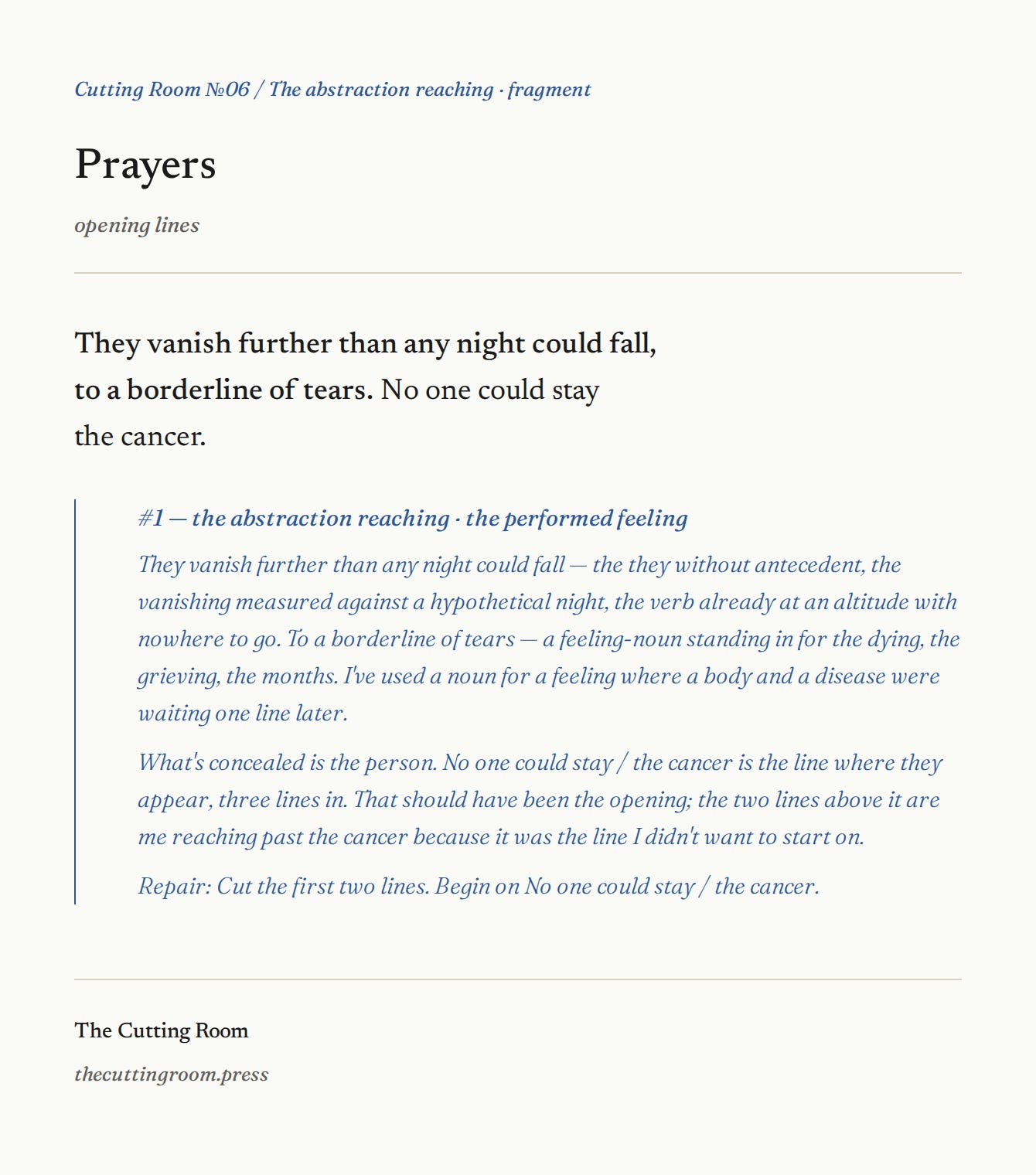
They vanish further than any night could fall,
to a borderline of tears. No one could stay
the cancer.
The opening three lines of a fourteen-line poem in 5–2–5–2. The poem is about a death from cancer; the rest of it stays closer to the dying — to particular images of the late summer, the doctors’ failed turns, the resignation of the survivors. Those lines stay in the drawer for further revision. Only the opening is on the slab — the two lines that reach, and the line they collapse onto.
The autopsy
— #1 The abstraction reaching (sub-case: the performed feeling)
They vanish further than any night could fall — the they without antecedent, the vanishing measured against a hypothetical night, the verb already at the metaphorical altitude where the sentence has nowhere left to go. To a borderline of tears — the feeling-noun standing in for the dying, the grieving, the room, the months. I’ve used a noun for a feeling where a body and a disease were waiting one line later.

Photo by Hush Naidoo Jade Photography on Unsplash
What’s concealed is the person. The poem has them: No one could stay / the cancer is the line where they appear, three lines in. That should have been the opening. The two lines above it are me flinching from the appearance — reaching past the cancer with a hypothetical night and a borderline made of tears, because the cancer was the line I didn’t want to start on.
The fragment also shows the cost of where the failure sits. Openings are load-bearing in a way middle lines aren’t; the first frame the reader receives is the frame the rest of the poem is read against. By starting on abstraction, I’ve licensed the whole draft to keep reaching. Tears recurs through the next stanza; prayers arrives twice more after that. The opening has paid for them all in advance.
The repair. Cut the first two lines. Begin on No one could stay / the cancer. The 5–2–5–2 becomes 3–2–5–2 — which may or may not be the shape the poem wants, but it is the shape that doesn’t lie about where the poem starts.
The general lesson
Two notes I’m taking from this autopsy, both about openings.
First: where an opening reaches for abstraction, the thing it should have entered through is often waiting one or two lines below. In Prayers it is line three: the cancer. I’ve gone back through a handful of my own drafts since seeing this, and the same shape keeps recurring — the first lines perform the mood, then a later line, often unforced, names what the mood was about. The repair is almost always the same. Cut the performance. Begin where the seeing begins.
Second: a single feeling-noun — tears, fear, grief, longing, loss — can carry an opening if the surrounding image earns it. Three in the first stanza is the diagnostic threshold. The poem has stopped showing and started naming. In Prayers, tears recurs three times across the first seven lines, and prayers arrives twice more after that. The recurrence isn’t motif. It is the same reach repeating, in lieu of the thing the poem is trying not to look at.
— Adam